How Much Do Art Studios Rent for in Asheville
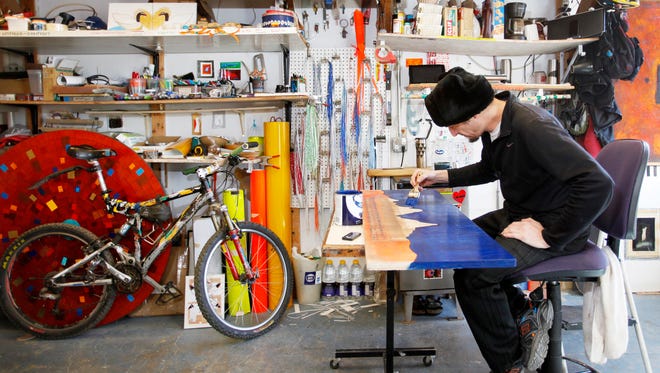
ASHEVILLE - Upwards the loading dock ramp and toward the back of Phil Mechanic Studios, Stephen Louis Lange hunched over a large slab of wood in his studio. Paintbrush in hand, he layered streaks of dark blue beyond the outline of a mountain range — sweeping the brush back and forth, leaving the forest slick and moisture and sparkling in the afternoon sun.
"Yous actually caught me painting," he said. "Just I'm not a painter. I generally do collage."
Hanging in the space around him, colorful pieces lined the walls, spliced together and woven from sparse strips of reflective tape.
Lange's work is displayed and sold in galleries all over the country — and he sells quite a bit from his studio also — simply even as an established artist on the Asheville scene, Lange knows that making a living with his creations isn't like shooting fish in a barrel work.

"I had my first child in 2005, and I had three jobs," he said. "I bartended, I worked at Laughing Seed on weekends, and then I did this during the day. So I got information technology down to just two jobs: this place and managing a eating place in West Asheville. And in 2009, I quit my day job," condign an artist full time.
That said, "last year was 1 of the toughest years I take ever been through," Lange said. "Because of HB2, all of a sudden that clientele stopped coming into my studio — stopped coming to North Carolina. I had a couple of really potent collectors from out of state tell me that they weren't going to spend money in North Carolina. … That was rough."
For Lange, the lull in business meant a canceled almanac trip to the embankment and an accumulation of credit menu debt, unfortunate but manageable, which he expects to pay off in 2017. Simply for emerging artists, having a rough season can hateful the difference between another year selling piece of work at a local gallery and leaving boondocks birthday.
'Difficult to establish yourself'
Christy Kirk, an Asheville human figure painter, recently decided to move out of land, hoping to go on her fine art career in Minneapolis, where she heard the arts scene is more inviting to emerging talent. Having spent near of her life in Western North Carolina, moving away wasn't a option she made lightly.
"Asheville feels so much like home," Kirk said. "But it's really difficult to establish yourself equally an artist, especially in an artsy town similar Asheville. … There are so many artists here, and it's really competitive. … I know a lot of artists who piece of work many jobs, myself included."
Merely working multiple, often function-time jobs to sustain an art career can exist a counterproductive effort.
"You lot're tired at the end of the day, so it's harder to come dwelling and create art," Kirk said. "It's a vicious cycle. You take to make money, just and then you don't have time to create. And when you don't create, you lot aren't focusing on your career or getting into galleries."
Asheville, though, seems plenty welcoming to those coming from larger, well-known artistic cities around the land. Kathryn Amorastreya, for case, simply moved to Asheville from San Francisco.
"I meet Asheville every bit very friendly to the arts — correct now," she said. "Even so, I do fearfulness that if Asheville fails to make moves to protect the arts and artisans who draw in the tourist crowds. ... (Asheville) may endure the same fate of other gentrified cities that take gone before (it)."
Amorastreya spent viii years in Austin, Texas, and 10 years in San Francisco. And sadly, she said, "I watched the same pattern happen: The artisans who create the civilization of a identify brand information technology desirable. Wealthy people motion in ... and, as well oft, rents rise and the artists get pushed out, leaving yet another yuppy town — Anywhere, America — full of the same old corporate bondage.
"San Francisco has seen a mass exodus of artists and musicians over the past few years, every bit hire has skyrocketed due to the tech industry," she said. "The city now feels sterilized and stripped of its once thriving and diverse civilisation. ... If cities ignore their artists during a growth menstruum, they will end up losing the very heart and soul that gave information technology life in the first identify."
She said that she hopes politicians, businesses and others outset to realize the importance of the arts, "otherwise their (city's) culture volition look like a field after a plague of locusts."
Luckily for Asheville, in that location's already a huge emphasis on the urban center's arts civilization, with a multimillion-dollar effort underway to revitalize the River Arts Commune, renovating buildings, linking the RAD to the metropolis's greenways and efforts to increase the area'southward safety as well as its visibility in town.
But, like Amorastreya, Lange worries that these improvements won't help develop a thriving arts culture for the hereafter generation of artists.
"It'due south losing the fact that it needs to be an incubator," he explained. "There needs to be, in the River Arts District, a project where they turn cheap aircraft containers into affordable studios for artists — with a potters' compound, a sculptors' compound — spaces designated as incubators for people who want to come here and immerse themselves in the arts, proceed the wheels turning. Because you accept people that can't afford a really nice studio similar this one, and they don't make it fifty-fifty though they have the talent."
Working every bit a for-hire professional person
While some artists piece of work role-time jobs to support and build an arts career, others start off equally for-hire professionals in the field, creating commissioned work and illustrations for clients to use in magazines, newspapers, advertisements, logos, etc.

"I started creating art for myself probably in 2014," said illustrator Fian Approach. "But I've been an illustrator for over xx years on a worldwide level. I came to Asheville ... and was like, 'Hey, maybe I'll kickoff selling prints online' — some of my watercolors and the stuff I usually practise for myself. For me, art is kind of like therapy for when I'm not working on a deadline. I thought, 'I should outset selling some of these.'"
So Approach opened a shop online, then got his work into ZaPow art gallery.
"Side by side affair I know, I'k in Woolworth Walk, and now I'm in a gallery in Savannah, which is totally kicking ass. It only kind of took off really quick," he said. "Maybe one day I'll quit illustration and only focus on this. ... But with the coin that illustration provides, I can accept my fourth dimension with my art. There's no urgency" in creating new pieces to sell.
The aforementioned tin can exist said for creative person and illustrator Andy Levine, who works professionally under the pen name John Nebraska.
"I'm a little bit older," he said. "I'thousand 60, and I've been around the block a couple of times as an artist. I've been in Asheville for about v years, and I lived in New York City for over 35 years where I was an illustrator, working for all the newspapers. The New York Times even so uses some of my illustrations and then does the Wall Street Journal."
When he sold his home in New York to move to Asheville, though, he said he began to brand more than art creatively, rather than through committee.
"Analogy has to have a specific narrative to information technology, but art means that I can exercise what I want," Levine explained. "I still do some illustrations — I'm doing a book cover right at present — but I mostly sell prints and originals."

Levine shows and sells work in galleries all effectually Western North Carolina — but he credits a huge office of his creative success to using social media as a marketing tool, creating his ain personal brand that people can follow. Levine also teaches art classes from his Haw Creek in-home studio, a tactic many artists in Asheville use — whether to earn extra cash, stay afloat or give back to the community.
Because of his social media post-obit, "I sell outside of Asheville quite a flake," Levine said. "Originals, prints, private commissions. If you stick to just Asheville trying to brand a living, it'south not going to work out. I take an Etsy shop. I'yard on every social media site in that location is. I've built up a post-obit, and information technology gets people to buy my stuff."
'RAD is an (interesting) model'
Some artists don't need the River Arts District, Lange said, leaning dorsum in his chair at Phil Mechanic. Levine is i instance, Arroyo is another. And Lange rattled off a list of others who piece of work from basements and spare bedrooms all over town — artists who aren't listed in the official RAD studio directory, which covers more than than 220 artists working in a ane-mile strip of boondocks.
"There are lots of really, really, really good artists that don't need the RAD," he reiterated. "Information technology's a lark. They might accept had a studio at one time, but got into galleries and realized they don't like (to work with) people peeking in the windows ... and touching their piece of work. The RAD is an (interesting) model. You lot have artists creating something cute every bit well every bit something they can sell, and they're doing it from a studio that's cleaned up enough to where information technology'due south comfortable for people to come in to buy their pieces."
Lange pointed to a mini-fridge to his right, the top covered in scraps of tape, papers and brushes.
"I have beverages. I accept beer and wine, and i of my favorite things to practice is, when I sell a nice painting to a collector, I shut my studio downwards and accept them (out to eat)," he said.
"People are curious virtually what an artist's life is like. (When you visit a studio), you're walking into something that'southward a cross between a church, a museum and someone'due south mind. The amusement park attribute (of the River Arts Commune) needs to be cerebral, well-nigh what you see, how the colors make you experience. In one case yous get-go expecting me to jump through hoops, I'one thousand done. I'thousand non in the entertainment business."
But in the 17 years Lange has worked in the River Arts Commune, first in Curve Studios, and then in the Wedge building and now at Phil Mechanic, he's seen a massive increment in the number of people visiting the area — and, ultimately, that's good news for the artists who demand to sell work to survive.
"And I would not get that if I didn't take a studio that's open to the public." Already recovering from the lows of 2016, Lange added, "if this year keeps going the mode it'south going, I'k taking my kids to Hawaii," hoping to make upwardly for terminal year'southward canceled trip to the Atlantic coast.
The RAD as well provides artists with entrepreneurial opportunities to help both themselves and other artists connect with the community around them.
John Almaguer, a glass artist working on Roberts Street, started the Asheville Art Studio Tours, now collaborating with Spring Frog Tours, to aid visitors and nonartist locals amend understand the artists in town.
At each stop on Almaguer'south two-hour ride effectually the RAD, the resident artist or artists stop to give some groundwork on their work — leading a tour of the studio and giving demonstrations on their craft.
'Nosotros use everything we've got'
Sitting at her bicycle, hands resting on a lump of clay, Sarah Wells Roland, owner of The Village Potters, chatted with visitors as she began spinning, pulling, crafting a vase in front of a pocket-size crowd.
"I've sold my piece of work all over the U.s., and that'south what made The Village Potters possible," she said, wetting the gray-brown object on her cycle.
After she founded the local pottery visitor, she realized she missed the chatter and company of having other artists and visitors in her studio. So Roland decided to open it upward to other resident artists and bring in visiting skilful potters, "not only to learn something myself, but to make money in the procedure through workshops."
"The thing near artists is that we utilize all of the elements," Roland said, holding a torch to her newly crafted vase. "We use the earth, we use burn down, water — nosotros employ everything nosotros've got."
And that works both literally and every bit a metaphor, as artists have to exist crafty (pun intended) to arrive in their fields.
"Existence an creative person is like — how do I put this?" Arroyo said, pausing a moment to recall. "Information technology's like you're a professional evidence-and-teller. I never got past fourth-grade show-and-tell. ... Similar, 'Hey! Look what I drew today!'"
He laughed long and difficult, and so straightened himself out. "One affair that I've always used as a philosophy to help with art — with anything, actually — is that you don't just sit around waiting for the phone to ring," he said. "Go out and make it ring. Y'all can't only wait around and promise to be discovered. Yous have to be professional; you have to make your deadlines. You have to market yourself and promote yourself."
And, Levine added, you take to create quality work that people will reallydesire to buy. While that seems obvious, toning down your personal tastes to cater to a wide multifariousness of people is harder than information technology seems.
"Information technology took me years to get my craft down and then that I was doing professional looking-work that was highly-seasoned to people," he said. "Asheville'southward a big tourist town, and i has to gear their work to things that a tourist might desire to accept home and put over their pall — or give as a souvenir. So you take to pander a bit and cater to your market.
"The more you get away from the eye line, the harder it is to sell," he said. "If you're hanging a used Band Aid from a toothpick on a string, you might not brand a whole lot of money. In Asheville, you tin sell lots of beautiful oil paintings of the Blue Ridge Mountains, considering that's what tourists relate to."
Looking up at the walls of his studio, Lange pointed to several wide collage pieces, landscapes of the mountains in varying colors — sunsets, snow, greenery. Those are the pieces he knows he can sell, he said. They fly out of his studio and stop upwards on mantles in New York, Louisiana, Florida, Colorado — and they're priced far below some of his less-adept pieces.
"Mount Pisgah, State of the Heaven," he said. "I but finished No. 167."
vergarawillne1983.blogspot.com
Source: https://www.citizen-times.com/story/news/local/2017/03/11/affording-asheville-artist/98255092/
0 Response to "How Much Do Art Studios Rent for in Asheville"
Post a Comment